Saturday, August 10, 2024

Franz Liszt

Franz Liszt


By Jesse Preis

Explore the genius of Franz Liszt, including his most popular music

Franz Liszt was a Hungarian composer, pianist, conductor, and teacher who was popular during the Romantic period. His pianistic virtuosity, showmanship, and physical attractiveness made him so well-known that his fans started a movement that is now known as “Lisztomania.” He might be considered the world’s first rock star, with popularity similar to the modern-day Taylor Swift, The Beatles during the 60s and 70s, or Elvis Presley during the 50s and 60s. If you grew up watching cartoons such as Looney Tunes and Tom and Jerry, then you will already be familiar with Liszt’s music. Read on to learn more!


Franz Liszt: Biography


Born: October 22, 1811, Doborján, kingdom of Hungary, Austrian Empire [now Raiding, Austria]

Died: July 31, 1886, Bayreuth, Germany (aged 74)

Liszt was born into a musical family on October 22nd, 1811 in Doborján, Hungary (which is known today as Raiding, Austria). His first piano teacher was his father Adám, who began teaching him at the age of seven. At age nine, Franz began performing in concerts around the cities of modern-day Hungary, Austria, and Slovakia. Around this time, he also began taking piano lessons from Carl Czerny, who was a student of Ludwig van Beethoven.


At the age of 21, Liszt had the opportunity to see Italian violin virtuoso Niccolo Paganini perform in concert. Following this concert, he became determined to become a piano virtuoso of the same caliber as Paganini. Luckily, he was living in Paris, France, which at this time in history was known as the pianist capital of the world. His growing friendships with virtuoso pianists and composers such as Frederic Chopin, Sigismond Thalberg, and Alexander Dreyschock helped build his technical knowledge of the instrument.


Franz Liszt: Music & Most Famous Works


Liszt is not just well-known for his brilliant compositions, but for his arrangements and transcriptions of other composers’ works as well. Here are some examples of his most famous arrangements and original works.


Probably best known is his Hungarian Rhapsody no. 2, which comes from a set of 19 Hungarian-themed rhapsodies. This piece has been referenced in many cartoons, including Looney Tunes (performed by Bugs Bunny) and Tom and Jerry (performed by Tom the Cat).

An example of his most romantic would be his Liebestraum no. 3 in A-flat Major. “Liebestraum” translates from German as the “Dream of Love”, which you can clearly hear in the tone that he creates if you listen here.

In his Grandes études de Paganini, Franz Liszt composed six etudes based on melodies written for the violin by Niccolò Paganini. These pieces are argued to be some of the most difficult pieces in the piano repertoire. The most famous is the Étude no. 3 in G# Minor, “La campanella”, which makes use of fast octave jumps, scales, arpeggios, and so much more. Watch and listen to this piece here!

Perfect for October (his birth month), Liszt’s Totentanz for Piano and Orchestra is based on the creepy Gregorian chant “Dies Irae” (“Day of Wrath”) and is frightening enough to keep you up on Halloween night!

Another Halloween classic is French composer Camille Saint-Säens’ La danse macabre, which Liszt transcribed and arranged for piano. Check out this piece here!

Liszt also transcribed and arranged Beethoven’s 7th symphony for piano. You can hear that by clicking here.

Relationship with Frederic Chopin

Liszt maintained friendships with several important composers, including Robert Schumann, Hector Berlioz, and Frederic Chopin (about whom you can learn more here). Liszt and Chopin are known as two of the greatest pianist-composers of the 19th century. They became acquainted when Chopin made his Paris debut in 1832. Liszt was in the audience and had the following to say:


“The most vigorous applause seemed not to suffice our enthusiasm in the presence of this talented musician, who revealed a new phase of poetic sentiment combined with such happy innovation in the form of his art.”


Although Chopin and Liszt became friends, their friendship was strained at times. There is an account that he performed a piece of Chopin’s, but with Liszt embellishing and adding to it. Chopin felt insulted and told Liszt that if he didn’t plan on performing it as written, he should not perform the piece at all. Liszt apologized, but whether that fixed the strained relationship is unknown.


Interesting Facts About Franz Liszt

Have you ever wondered why pianists often perform without sheet music and so many other instrumentalists such as violinists perform with sheet music? Thank Liszt! Before Liszt’s time, it was uncommon for pianists to perform without sheet music in front of them. In fact, pianists such as Chopin considered it an insult to the composer to play without sheet music. Liszt was a showman and enjoyed wowing his audience with his technical brilliance and his ability to play from memory. His personal performance technique influenced other pianists and the rest is history!

Although Franz Liszt was Hungarian, his first language was German and he didn’t learn his ancestral language until later in life. Despite this fact, he was known to be intensely proud of his Hungarian heritage.

Impressionism, the French compositional-style that is famously tied to composers like Claude Debussy and Maurice Ravel, is rumored to have been inspired by the use of whole tone scales and extended chords in his Années de pèlerinage.


With affection,

Ruben


Tuesday, August 6, 2024

José Sabogal

José Sabogal


Source: Wikipedia


Personal information


Birth name José Arnaldo Sabogal Diéguez

Born March 19, 1888

Cajabamba, Peru

Died December 15, 1956 (age 68)

Lima, Peru

Burial Cemetery Presbítero Matías Maestro

Nationality Peruvian

Family

Parents Manuela Diéguez de Florencia

Matías Sabogal

Spouse María Wiesse Romero

Children José, Rosa Teresa

Professional information

Occupation Painter, essayist, professor


José Arnaldo Sabogal Diéguez (Cajabamba, March 19, 1888 - Lima, December 15, 1956) was a Peruvian painter, professor and essayist. He was one of the first promoters and one of the leaders of the Peruvian indigenist 

 Biography


José Sabogal was born in the city of Cajabamba (Cajamarca) (Peru) on March 19, 1888 in a mestizo family, being the son of Matías Sabogal del Castillo and Manuela Diéguez de Florencia. In 1922 he married the writer María Wiesse Romero (1894-1964), daughter of the historian Carlos Wiesse Portocarrero. The marriage had two children: José Rodolfo Sabogal Wiesse (1923-1983) and Rosa Teresa Sabogal Wiesse (1925-1985).


The origin of the surname Sabogal is the Castilian word sabogal, which indicates a net to fish sabogas and which is mentioned in chapter XXIX of the second part of the old editions of Don Quixote de la Mancha. According to María Wiesse's book José Sabogal, the artist and the man, the painter's ancestors are believed to have come from a fishing village called Saboga in northern Spain.


José Sabogal traveled through Spain, southern France, Italy, and North Africa between 1908 and 1913 before beginning to study at the National School of Fine Arts in Buenos Aires (Argentina), where he studied for five years.23


Sabogal dedicated himself to promoting pre-Columbian culture and aesthetics.2 During a six-month stay in Cuzco, Sabogal became interested in depicting the city and its inhabitants in his paintings.3 In 1919, he held an exhibition of his paintings at the Casa Brandes in Lima, which attracted the attention of critics and the public.3


For José Carlos Mariátegui, Sabogal is the Peruvian painter par excellence. The reason is that Sabogal was the painter who broke with European academic colonialism and created his own national school with authentic Peruvian roots without being a copy of the dominant European art. Sabogal resurrected the artistic value, the roots and the dignity of the Peruvian in a unique, native, vernacular and original way. Sabogal decided to promote Peruvian art internationally after a visit to Mexico, where he met Diego Rivera, José Clemente Orozco and David Alfaro Siqueiros.3


From 1920, Sabogal taught at the Escuela Nacional Superior Autónoma de Bellas Artes del Perú3 and between 1932 and 1943 he served as director of this institution.3


 He was artistic director of the magazine Amauta, whose first issue, published in 1926, bears a drawing of his authorship on the cover. Sabogal and Luis Eduardo Valcárcel later founded the Instituto Libre de Arte Peruano (Free Institute of Peruvian Art) at the National Museum of Peruvian Culture.3 His work is part of the permanent collection of the Museum of Contemporary Art in Cusco.


His disciples include Camilo Blas, Enrique Camino Brent, Julia Codesido, Cota Carvallo, Jorge Segura, Aquiles Ralli, Gamaniel Palomino, Pedro Azabache Bustamante, Andrés Zevallos and Eladio Ruiz.

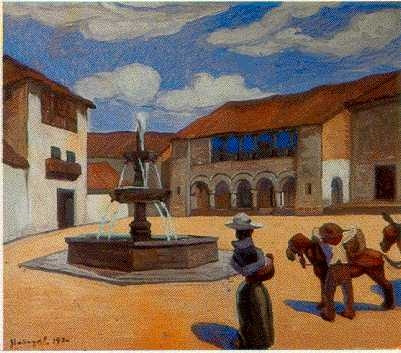
Art Works


With affection,

Ruben


Saturday, August 3, 2024

Camilo Blas


Camilo Blas


Personal information


Birth name José Alfonso Sánchez Urteaga


Born March 19, 1910

Birth March 19, 1910   

Flag of Peru Cajamarca, Peru


Peruvian Nationality


Family


Children Elena, Hilda, Berta and Gabriela


Education


Education National University of Trujillo, National School of Fine Arts


Educated at


National University of Trujillo

National Autonomous Superior School of Fine Arts of Peru

Professional information


Area Painting, Engraving


Indigenismo Movement

Professional information


Area Painting, Engraving


Indigenismo Movement


Pseudonym Camilo Blas


Member of Grupo Norte


Distinctions Culture Award in 1946


José Alfonso Sánchez Urteaga,1​ known as Camilo Blas (Cajamarca, March 19, 1903 - Lima, July 26, 1985), was a Peruvian indigenist painter.


Biography


Camilo Blas had Ana María Siles as his wife and his daughters are Elena, Hilda, Berta and Gabriela. Since childhood he showed his artistic spirit through drawings and sketches. Thanks to the support of his uncle, the Cajamarca artist Mario Urteaga, he took his first steps in painting.


He entered the National University of Trujillo to study Law, a career that he completed. He did his art studies at the National School of Fine Arts in Lima under the direction of Daniel Hernández and later with José Sabogal. His classmates included Ricardo Flórez, Camino Brent and Julia Codesido. From 1933, he was a professor of fine arts for many years and then Director of the School of Fine Arts in Lima.


With a refined style, within the indigenist current, he knew how to add a touch of subtlety and color of his own to his drawings.


Due to the large number of Peruvian costumbrist drawings that his works present, both from Cajamarca and from all of Peru, he is also considered the "Pancho Fierro serrano".


Pseudonym Camilo Blas


Member of Grupo Norte


Distinctions Culture Award in 1946


José Alfonso Sánchez Urteaga,1​ known as Camilo Blas (Cajamarca, March 19, 1903 - Lima, July 26, 1985), was a Peruvian indigenist painter.


Camilo Blas had Ana María Siles as his wife and his daughters are Elena, Hilda, Berta and Gabriela. Since childhood he showed his artistic spirit through drawings and sketches. Thanks to the support of his uncle, the Cajamarca artist Mario Urteaga, he took his first steps in painting.


He entered the National University of Trujillo to study Law, a career that he completed. He did his art studies at the National School of Fine Arts in Lima under the direction of Daniel Hernández and later with José Sabogal. His classmates included Ricardo Flórez, Camino Brent and Julia Codesido. From 1933, he was a professor of fine arts for many years and then Director of the School of Fine Arts in Lima.


With a refined style, within the indigenist current, he knew how to add a touch of subtlety and color of his own to his drawings.


Due to the large number of Peruvian costumbrist drawings that his works present, both from Cajamarca and from all of Peru, he is also considered the "Pancho Fierro serrano".


Art works   


 Andes Peru Landscape


Trujillo colonial house


Down to Paunamarco    


Sierra Peru landscape

Marinera Dance

Andes party


Procession Señor de los milagros

With affection,
Ruben


Wednesday, July 24, 2024

Gustavo Camino Brent 2


Gustavo Camino Brent 2


:

This painter became the pioneer of Peruvian indigenism


From his early years in Lima, Gustavo Camino Brent showed a remarkable talent that he would later express in a unique style within the Peruvian indigenist movement. (Enrique Camino Brent Collection – “Luis Jaime Cisneros” Center of the PUCP)

The world of the arts in Peru It has countless exponents in all branches, all with a talent that has left its mark on their specialty.


That is the case of Gustavo Camino Brentwho since childhood excelled in various disciplines, but stood out in painting. So much so that he became the first representative of what was called Peruvian indigenism. And this is his story.


The renowned painter made a significant contribution to Peruvian art by authentically depicting Andean cultures and landscapes in his works. (Indio del Collado – Oil on canvas – Enrique Camino Brent, 1939 – BCRP Museum)

Gustavo Enrique Camino Brenthis full name, was an influential Peruvian painter of the indigenist movement and was born in Lima on June 22, 1909. Son of Juan Francisco Camino Anderson and María Águeda Catalina Brent Delgado, he grew up in an environment that valued culture and the arts.


From a young age, Gustavo showed remarkable talent. At the age of three, he won a gold medal in a child beauty pageant.


She began her education with a private tutor and then attended the Colegio Sagrados Corazones Recoleta, continuing her studies at the Colegio San Agustín and culminating in Nuestra Señora de Guadalupe.


In 1922, he entered the National School of Fine Arts of Lima at just twelve years old. Despite the opposition of his father, Daniel Hernández, the school director, intervened so that Gustavo could continue his artistic studies.


Under the tutelage of Hernandez and Jose SabogalGustavo developed a distinctive style, far removed from the predominant European influences.


From his studies at the National School of Fine Arts in Lima to his international travels, discover the story of this influential artist. (Balcón de Herodes – Oil on canvas – Enrique Camino Brent, 1937 – Museo del BCRP)

Gustavo also studied architecture at the Lima School of EngineersIn 1932, he graduated with honors from the Fine Arts program and began teaching at the institution in 1937. His first exhibition in Lima in 1936 was praised, and his work began to gain international recognition.


But his search for inspiration led him to travel through the interior of Peru, exploring local landscapes and techniques, such as the ceramics of Santiago de Pupuja. In 1938, he married María Rosa Macedo Cánepa, with whom he had a son, Luis Federico Camino Macedo.


In other roles, Gustavo taught ceramics at the Jose Pardo Polytechnic and designed the chapel of the institute, which still preserves its original design. His travels through Puno and Buenos Aires inspired series on Collao and Cusco. In 1940, he returned to Lima and aligned himself with Sabogal, who was dismissed from the direction of the ENBA (National School of Fine Arts) in 1943.


During his trips to the United States, Mexico and Quito, Gustavo met Oswaldo Guayasamín and made murals, such as the one at the former Ministry of Public Education.


This notable artist not only left his mark on painting, but also on architecture and Fine Arts education in different institutions. (Red Staircase – Oil on canvas – Enrique Camino Brent, 1954 – Pinacoteca Ignacio Merino)

He was director of the Huamanga School of Fine Artswhere he also taught. His work, characterized by portraits and landscapes, combined a strong pictorial resonance with earthy colors.


One of his outstanding works is the “Christ of Tayankani” from 1951which reflects his fascination with popular religiosity. Despite his membership in the indigenist group, Gustavo maintained a personal line in his art, depicting the architectural landscape and the image of the Indian with an intense palette.


The Peruvian painter combined his training in architecture and his indigenous art to create works that resonated in America and Europe. (Christ of Tayankani – Oil on canvas – Enrique Camino Brent, 1937 – MALI)

In 1957, he took over the management of the School of Fine Arts and Crafts from the University of Ayacucho, where he continued until his death.


His vision of the vernacular world was reflected in his works, which captured corners and squares with a melancholic beauty. His works can be found in collections in America and Europe, with “El Recuerdo (La Capa)” from 1930 being particularly noteworthy.


In 1960, he returned to Lima due to severe headaches. Specialists determined that this was due to a malignant tumor lodged in your brain.


He passed away on July 15, 1960during an operation. His body was laid to rest in his workshop and buried in the San Andrés barracks of the El Ángel Cemetery.


With affection,

Ruben